
A Certificate of Waiver does not make every rapid test available to a pharmacy a CLIA-waived test. The FDA categorizes an exact test system, so the manufacturer, product, analyte, specimen, intended use, and instructions all matter.
This guide shows how to verify the product before your pharmacy orders or uses it. If you still need the certificate itself, start with our CLIA certification guide.
The waived list is product-specific
Use the FDA CLIA database as the current product lookup. It lets you search by test-system name or manufacturer, analyte, complexity, specialty, and effective date. FDA publishes current update information on its database pages, so record the date checked instead of assuming one refresh schedule applies to every search surface.
A category such as influenza, glucose, or strep is only a starting point. Two products that appear to answer the same clinical question may have different complexity categories or different waived specimen types. The pharmacy needs the record for the exact system it plans to use.
Stop when the record does not match
Do not treat a similar product name, a distributor page, an OTC shelf label, or another pharmacy's setup as proof. If the exact system is absent, uncategorized, nonwaived, or tied to different instructions, stop before patient testing and obtain qualified review.
Common categories still need an exact lookup
The FDA's currently waived analytes list includes commercially marketed systems across many testing needs. Pharmacy teams commonly encounter products for respiratory infections, strep, glucose, lipids, A1c, pregnancy, urinalysis, and selected infectious-disease screening.
That list is useful for discovery, but it is not a shopping list. A waived system for one specimen or intended use does not establish that a different system, specimen, patient population, or procedure is also waived.
Compare the exact product, not the box category
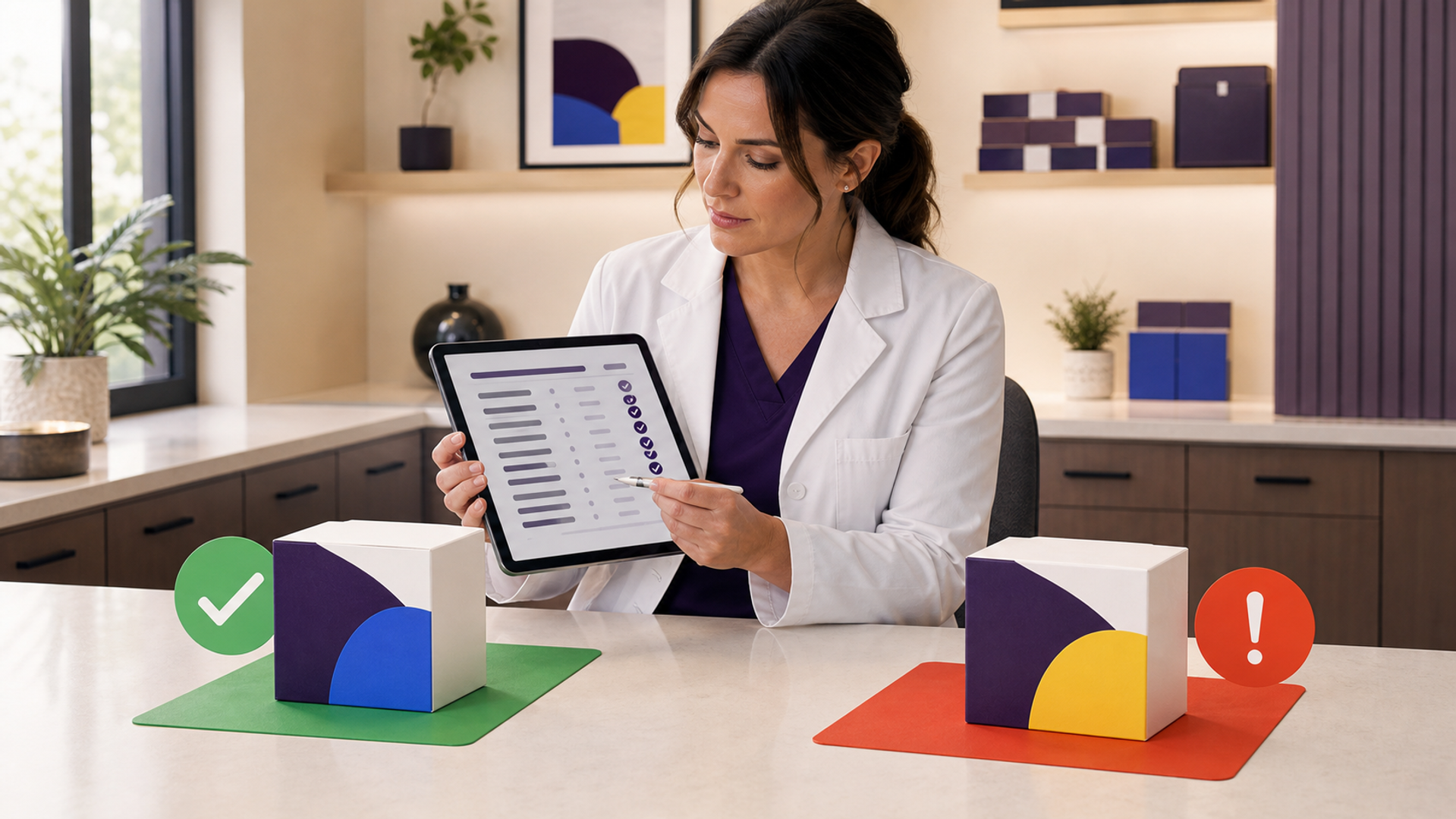
Consider an illustrative pharmacy preparing to buy 50 respiratory test kits for a fall clinic. The buyer compares two products that both advertise influenza and COVID-19 results.
- Product A appears in the FDA database as waived for the exact nasal-swab system and instructions the pharmacy will use.
- Product B appears as moderate complexity, even though its retail description sounds similar.
A pharmacy operating only under a Certificate of Waiver can advance Product A to the next reviews. It cannot substitute Product B or assume that a familiar analyte makes it waived. The 50-kit order stays on hold until the exact product record, current instructions, site certificate, state requirements, and clinical protocol all agree.
This example is illustrative. It does not describe the status of any real product, and it does not establish that either test would be within a pharmacist's scope or covered by a payer.
Keep one verification record for purchase and go-live
The buyer, clinical lead, and testing staff should be able to reproduce the same decision. Keep these fields together for each product:
- Exact manufacturer, test-system name, model or catalog identifier, and distributor item used for matching.
- Analyte, specimen type, intended use, patient population, and testing method in the current instructions.
- FDA complexity result, source link, document number if available, effective date, and the date the pharmacy checked it.
- Current manufacturer instructions and version, including storage, quality control, timing, result interpretation, and invalid-result handling.
- Testing location, CLIA number and certificate type, laboratory director, and certificate expiration or renewal date.
- State laboratory and pharmacy review, clinical protocol owner, payer or program questions, training owner, go-live decision, and next recheck date.
- Stop trigger for a changed product, instructions, specimen, intended use, clinical protocol, site, certificate, or governing requirement.
Changing the instructions can change the CLIA status
CMS interpretive guidance says a Certificate of Waiver site must follow the current manufacturer instructions, including the approved specimen type and quality-control requirements. A waived system used outside those instructions becomes uncategorized and is treated as high complexity.
That means a shortcut can change the regulatory question. Using a different swab, specimen, timing window, reagent amount, interpretation rule, or patient population may require a stop even when the product was waived under its cleared instructions.
CLIA status does not answer every pharmacy question
Federal CLIA status answers which certificate complexity can perform the exact system under the stated conditions. It does not decide whether state law lets the pharmacy or pharmacist offer the service. CMS notes that separate state laboratory requirements may apply. Pharmacy scope, ordering or protocol requirements, result reporting, referrals, and public-health reporting need their own current review.
CLIA status also does not establish a billing code, coverage, medical necessity, network status, allowed amount, or payment. Review our pharmacy CPT code guide and the medical benefit versus pharmacy benefit guide for the next layer, then confirm the current payer and program rules for the exact service.
Waived still requires controlled testing
The CDC's Ready? Set? Test! booklet is written for waived testing sites, including pharmacists. It emphasizes that waived tests are not error-proof and provides practical controls for preparation, instructions, quality checks, result handling, and records.
The pharmacy's verification record should therefore survive the purchase decision. Recheck it when staff introduce a new lot, new instructions, a replacement product, a different site, or a revised clinical workflow.
DocStation supports custom assessments with required fields, scoring, and conditional branching. A pharmacy can use that capability to make its approved clinical protocol easier to follow, while the pharmacy's qualified reviewers remain responsible for the protocol and test decision.
Questions pharmacy teams ask about CLIA-waived tests
Can a pharmacy run any waived test with a Certificate of Waiver?
No. The site must use an exact test system categorized as waived and follow its current manufacturer instructions. State laboratory law, pharmacy scope, and clinical requirements can add separate limits.
Are over-the-counter tests CLIA-waived?
FDA-cleared or approved home-use tests are automatically categorized as waived. That does not remove the need to match the exact product and instructions or answer the separate site, pharmacy-scope, protocol, and reporting questions.
What if the exact test system is missing from the FDA database?
If you cannot confirm an exact match, stop and resolve it using the current manufacturer labeling, FDA clearance or CLIA record, and qualified compliance review. A missing search result alone does not prove that the product is uncategorized. If the test is modified or genuinely uncategorized, CMS treats it as high complexity rather than waived.
Does waived mean the test cannot produce a wrong result?
No. Waived systems are simple and carry a low risk of error, but the CDC says no test is error-proof. Current instructions, training, quality practices, result interpretation, and follow-up still matter.